Complete Guide to Custom Software Development
A complete but practical guide to custom software development, covering where custom builds make sense, what to plan first, and how to avoid costly rework.
Key Takeaways
- 01
Custom software services should include scope thinking, engineering discipline, and support planning.
- 02
Buyers should compare what each proposal actually includes, not just the headline price.
- 03
Discovery and QA are not optional extras when delivery quality matters.
- 04
The strongest providers connect product decisions to technical execution.
- 05
A clear process is one of the biggest predictors of a healthy engagement.
Complete Guide to Custom Software Development matters because buyers and founders need a clear answer, not a vague range or a stack of agency buzzwords. This guide explains custom software development in a commercially realistic way so you can make better product, budget, and delivery decisions.
The short version: good software services are not just coding hours. They combine discovery, product thinking, design, engineering discipline, release process, and post-launch support.
Quick answer
custom software development should be evaluated through scope, delivery risk, and business usefulness, not just a headline number or trend-driven opinion.
- Strong engagements define goals, scope boundaries, milestones, and quality expectations early.
- Good service partners reduce ambiguity instead of billing around it.
- The best outcomes come when product and engineering decisions stay connected.
Who this guide is for
This guide is for companies evaluating external product and engineering support, especially when off-the-shelf tools no longer fit the workflow.
What good software delivery service includes
At a practical level, good software service means someone is thinking through product logic, edge cases, QA, deployment, and what happens after launch. It is not just a line item for frontend and backend hours.
Buyers get better results when the engagement structure supports decision-making, not just task execution. That is where discovery, design review, and regular demos become commercially important.
| Decision point | Custom build makes sense when |
|---|---|
| Workflow fit | Off-the-shelf tools force too many compromises |
| Differentiation | The software supports a unique process or business model |
| Integration needs | Multiple systems must work together reliably |
| Control | You need ownership over roadmap, data, and UX |
Modern businesses increasingly rely on software to manage operations, serve customers, and build digital products. While many organizations use off-the-shelf tools, these solutions often fail to address unique business needs.
Custom software development allows companies to build tailored applications designed specifically for their workflows, business logic, and scalability requirements. Instead of adapting processes to generic software, businesses can build solutions that match how they operate.
This guide explains what custom software development is, why businesses choose it, and how companies successfully build scalable custom systems.
What Is Custom Software Development?
Custom software development is the process of designing and building software solutions specifically tailored to the needs of a particular organization. Unlike commercial software products built for mass markets, custom solutions focus on solving a company’s unique problems.
Custom software may include web applications, internal management systems, enterprise platforms, SaaS products, or automation tools.
These systems are designed with specific workflows, integrations, and scalability requirements in mind.
Why Businesses Choose Custom Software
Companies often choose custom software when existing tools cannot support their business processes efficiently. Tailored software allows organizations to operate more effectively and build competitive advantages.
Some of the main reasons businesses invest in custom software include:
- Automation of internal processes
- Integration with existing systems
- Improved scalability
- Enhanced security and control
- Better user experience for employees or customers
Custom solutions also allow companies to innovate without being limited by generic platforms.
Types of Custom Software Solutions
Custom software can be developed for many different use cases depending on business requirements.
Web Applications
Many companies build web-based platforms for customers or internal teams. These systems are accessible through browsers and can scale easily with cloud infrastructure.
Enterprise Software
Large organizations often require enterprise platforms to manage data, operations, and collaboration across departments.
SaaS Products
Startups frequently build SaaS products that deliver services through subscription-based online applications.
Automation Tools
Automation software helps businesses eliminate repetitive tasks and increase operational efficiency.
The Custom Software Development Process
Successful custom software projects follow a structured development process that ensures quality and scalability.
1. Discovery and Requirements
The development team works with stakeholders to understand business goals, workflows, and system requirements.
2. Product Planning
Product managers and architects define the system architecture, feature roadmap, and development milestones.
3. UI and UX Design
Designers create wireframes and interface designs that ensure the product is intuitive and user-friendly.
4. Development
Engineers build the frontend, backend, and database systems required to run the application.
5. Testing and Quality Assurance
Testing ensures the software performs reliably and meets functional requirements.
6. Deployment
The software is deployed to production infrastructure where users can access it.
7. Maintenance and Scaling
After launch, teams continue improving the product through updates, optimizations, and feature additions.
Benefits of Custom Software Development
Custom software offers several advantages compared to off-the-shelf solutions.
- Flexibility: Businesses control features and functionality.
- Scalability: Systems can grow alongside the company.
- Integration: Custom tools can connect with existing platforms.
- Security: Tailored systems often provide stronger control over sensitive data.
- Competitive advantage: Unique software capabilities can differentiate businesses from competitors.
Cost of Custom Software Development
The cost of custom software depends on product complexity, features, integrations, and team size.
Typical cost ranges include:
- Small business applications: $20,000 – $50,000
- Mid-scale platforms: $50,000 – $150,000
- Enterprise systems: $150,000 – $500,000+
Many companies begin with smaller MVP versions of their software before expanding into full systems.
How Long Does Custom Software Development Take?
Project timelines vary depending on complexity. Basic applications may take two to three months to develop, while large enterprise systems may require six to twelve months.
Agile development methods allow teams to deliver features incrementally while maintaining flexibility.
Choosing the Right Development Partner
Selecting the right development partner is essential for successful custom software projects.
Companies should look for teams that offer:
- Strong technical expertise
- Transparent communication
- Clear development processes
- Scalable architecture planning
- Post-launch support
A reliable development partner works closely with clients to align technology decisions with business goals.
Common Challenges in Custom Software Projects
While custom software offers many advantages, projects can face challenges if not managed carefully.
Common issues include unclear requirements, scope changes, and poor communication between stakeholders and development teams.
Strong project management and iterative development processes help mitigate these risks.
Future of Custom Software Development
The demand for custom software continues to grow as businesses adopt digital transformation strategies. Cloud computing, AI-driven systems, and scalable web platforms are shaping the next generation of custom applications.
Organizations that invest in tailored technology solutions gain greater flexibility and long-term scalability.
Conclusion
Custom software development allows businesses to build systems designed specifically for their needs. By focusing on scalability, usability, and integration, companies can create powerful digital platforms that support long-term growth.
Working with experienced development teams ensures that software solutions are reliable, maintainable, and aligned with business objectives.
When custom development services make sense
Custom development is usually justified when the workflow is a competitive advantage, off-the-shelf tools no longer fit, or several systems must work together around your business process.
Common buyer mistake
Many buyers compare vendors as if service means the same thing everywhere. In reality, one proposal may include discovery, QA, and launch support while another mostly covers implementation hours.
Buyer checklist
- Confirm what discovery outputs are included.
- Check how design, engineering, and QA are coordinated.
- Review milestone structure and reporting rhythm.
- Clarify support after launch.
- Ask how changes to scope are handled.
For more planning support, see our custom software development services, software consulting support, and contact our team.
What to do next
Compare service providers by how they define the work, show progress, and protect maintainability after launch. Good software delivery is visible, structured, and commercially grounded. To discuss your own build, visit our custom software development services or contact our team.
Apply this in a real project
If you’re planning to build or improve software based on these ideas, our custom software development services can help you define scope, reduce delivery risk, and ship maintainable systems.
For founder-led execution, explore our product development services and software consulting services to turn requirements into a working release with clear ownership.
Expert Insights
Delivery quality is visible in the process
The presence of discovery outputs, milestone discipline, QA, and post-launch thinking usually tells you more about service quality than portfolio screenshots alone.
Software services should reduce ambiguity
A good provider clarifies priorities, boundaries, and tradeoffs early instead of profiting from uncertainty later.
Tags
Frequently Asked Questions
What is included in custom software development services?+
How should buyers compare service providers?+
When should a business choose custom software?+
What makes an engagement go wrong?+
How long do custom projects usually take?+
Reader Questions
Should I expect strategy help from a service provider?
A strong provider should contribute to scope clarity and delivery tradeoffs, even if you own the business strategy.
What does a healthy kickoff look like?
A healthy kickoff aligns goals, scope, assumptions, communication rhythm, and what success looks like for the first milestone.
How do I avoid becoming dependent on one vendor?
Insist on documentation, repo access, predictable handover, and visibility into architecture and delivery decisions from the start.
Related Articles
Technology • 3 min
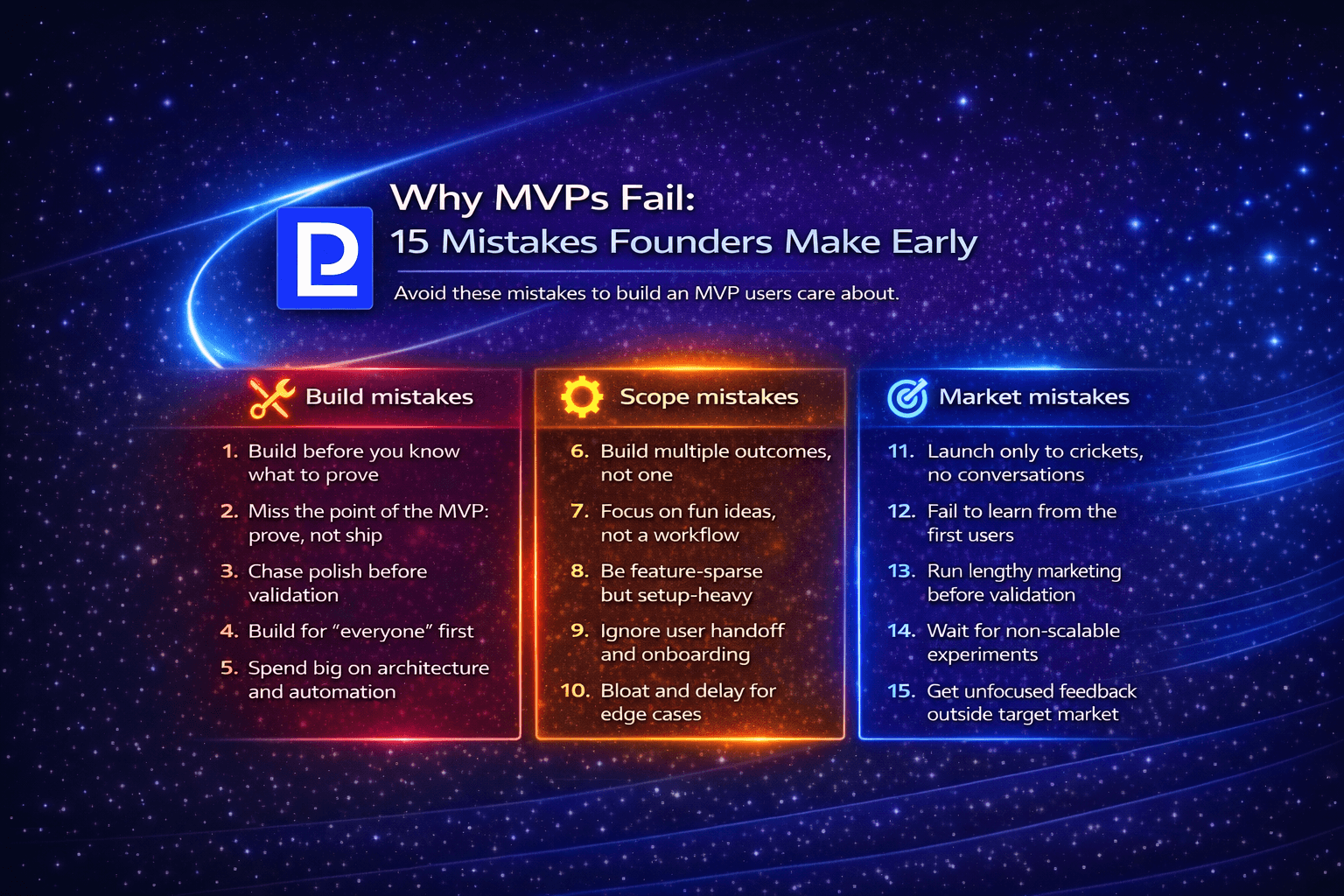
Why MVPs Fail: 15 Mistakes Founders Make Early
A founder-focused guide to the 15 most common MVP mistakes: what causes failure, how to avoid them, and how to build MVPs that actually validate.
Technology • 3 min
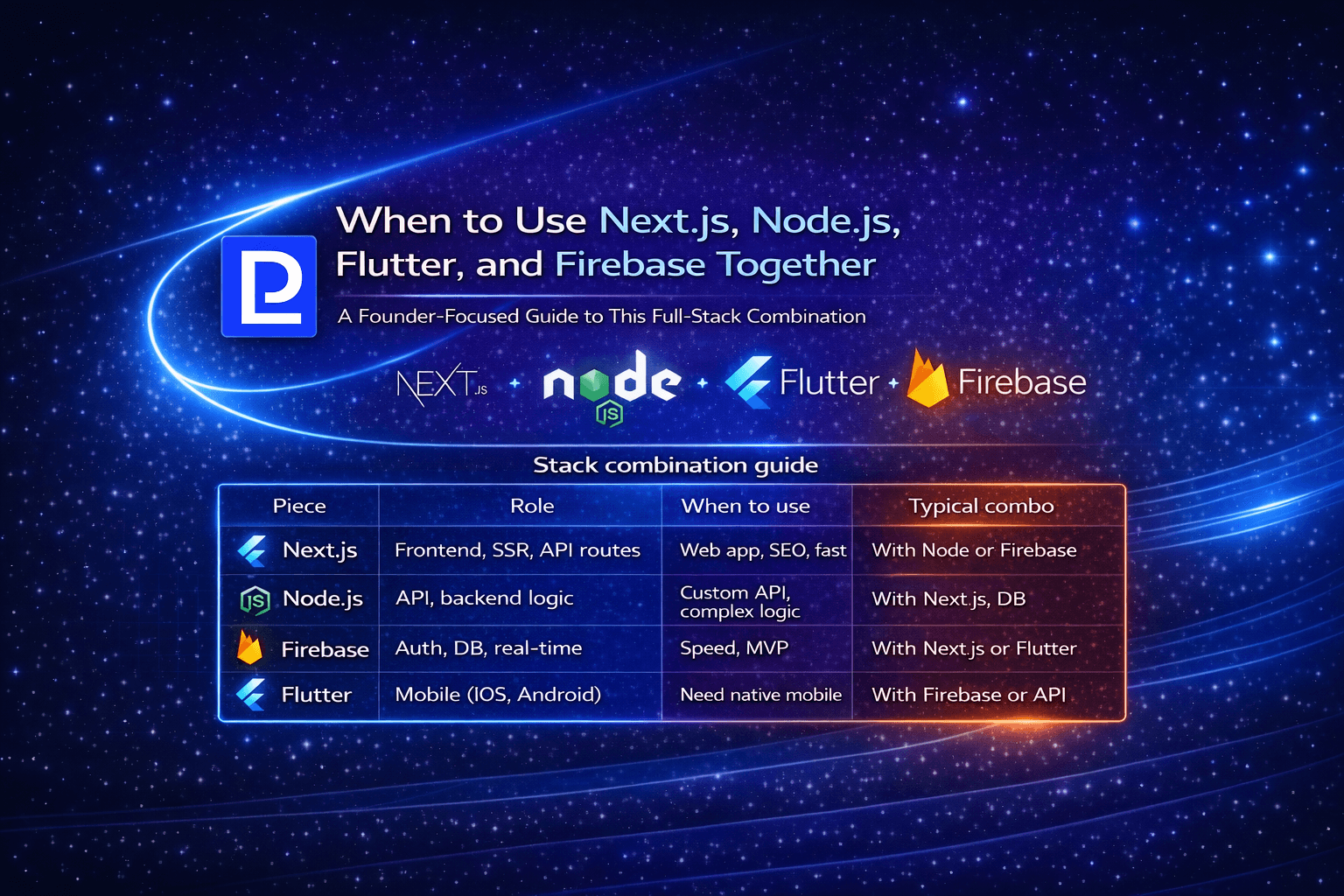
When to Use Next.js, Node.js, Flutter, and Firebase Together
A founder-focused guide to combining Next.js, Node.js, Flutter, and Firebase: when the stack makes sense and how to use them together.
Technology • 3 min
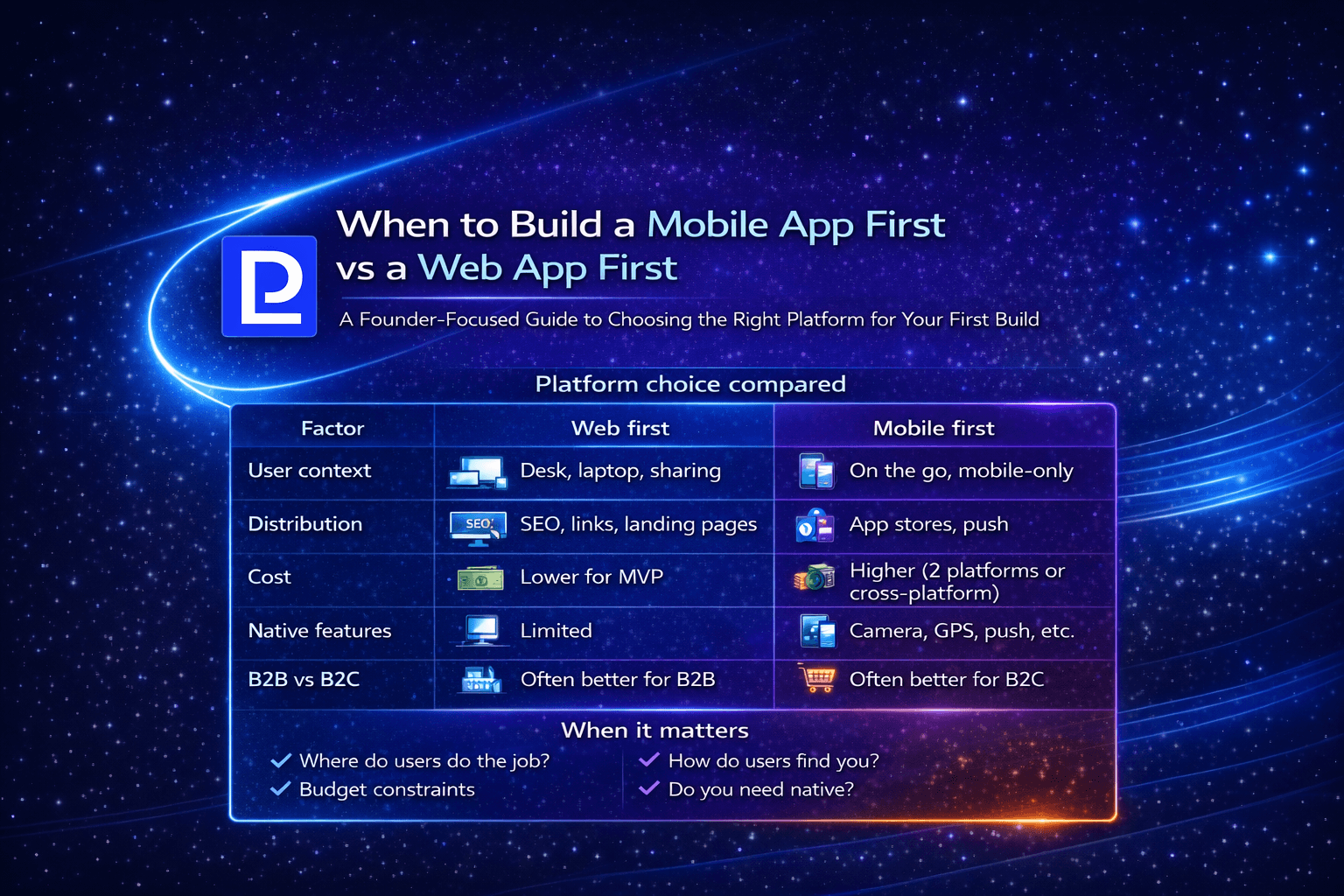
When to Build a Mobile App First vs a Web App First
A founder-focused guide to choosing mobile-first vs web-first: when each makes sense, tradeoffs, and how to decide for your product.