Next.js vs React for SaaS Products
A practical Next.js vs React comparison for SaaS products, including tradeoffs in SEO, developer speed, hosting, and long-term product flexibility.
Key Takeaways
- 01
Next.js vs react works better when founders tie scope to a concrete business outcome instead of a broad wishlist.
- 02
Quick verdict: Most startup SaaS teams should default to Next.js unless they have a strong reason to own routing, rendering, and deployment decisions manually.
- 03
Strong framework comparisons decisions come from clear tradeoffs around budget, speed, reliability, and team capacity.
- 04
Shorter, clearer sections make the article easier to scan and easier for buyers to act on.
- 05
Common founder mistake: Assuming plain React gives more flexibility and therefore is automatically the smarter startup choice.
- 06
The best next step is usually a narrower plan with a stronger first release, not a larger backlog around Next.js vs react.
Next.js vs React for SaaS Products matters because buyers do not reward software that is only technically correct. They reward software that solves a real workflow, looks credible, and is easy to evaluate. A practical Next.js vs React comparison for SaaS products, including tradeoffs in SEO, developer speed, hosting, and long-term product flexibility.
If you are researching next.js vs react, the useful questions are practical ones: what should be built first, what should be delayed, where does the budget really move, and which tradeoffs are worth making now. That is the frame this guide uses.
Quick verdict
Next.js vs react should be judged by launch speed, operating simplicity, hiring reality, and how easy the product is to maintain after version one.
- Pick the option that reduces delivery friction for the next 12 months.
- Use the product shape as the decision frame, not framework popularity.
- Prefer clarity over theoretical flexibility if the team is small.
Who this comparison is for
This article is for founders and buyers making a real stack choice under schedule pressure.
It is most helpful when the team needs a usable default and wants the tradeoffs explained in business terms rather than in abstract developer language.
- Useful when reviewing a vendor recommendation.
- Useful when one choice looks trendier but the other may ship faster.
- Useful when the team needs a decision that will still feel sane six months from now.
Next.js vs react at a glance
A strong comparison table should let a founder scan the decision quickly before reading the deeper tradeoffs.
| Decision area | Next.js | React |
|---|---|---|
| Time to first release | Faster when Next.js conventions match your use case | Faster when you want lower framework opinion and already know how to compose the stack |
| Hiring and familiarity | Usually better when the existing team already uses the ecosystem heavily | Better when you want wider low-level flexibility or a different skill mix |
| Operational complexity | Lower if Next.js ships the defaults you need | Lower only when your team wants to own more of the setup directly |
| Best fit | a sales ops SaaS that needs SEO landing pages, logged-in dashboards, and fast iteration by a small team | Teams with stronger custom requirements and clear reasons not to follow Next.js's default path |
The real tradeoff
Most comparisons become noisy when they focus on what each tool can theoretically do. Founders need a narrower frame: which option makes a trustworthy launch easier, which one creates less maintenance drag, and which one fits the team you actually have.
| Question | What to ask |
|---|---|
| Launch speed | Which option lets the team move from scope to reviewable product faster? |
| Team fit | Which option is easier for current and likely future hires to work with? |
| Operational burden | Which one adds more setup, deployment, or architectural ownership? |
| Commercial fit | Which one supports the product shape without adding unnecessary cost? |
When option A is the better choice
- When the team benefits from stronger defaults and faster setup.
- When consistency and speed matter more than owning every layer manually.
- When the product roadmap is still changing and the simplest reliable path is worth more than extra control.
When option B is the better choice
- When the team already has strong internal patterns and knows why the extra ownership is worth it.
- When the product has constraints that genuinely require a less opinionated setup.
- When the additional complexity is intentional rather than aspirational.
Common evaluation mistake
The biggest mistake is assuming flexibility is automatically valuable. Extra flexibility only helps when the team can actually use it without slowing delivery.
Founder note
Framework comparisons become more useful when combined with early software consulting or product development planning, because the tool choice is only half the decision. The delivery model matters just as much.
Final comparison checklist
- List the product surfaces you must ship in the next two releases.
- Map those requirements against the team you have now.
- Ask how the choice affects maintenance after launch, not just development during week one.
- Choose the option that makes shipping easier to repeat.
- Avoid making a frontend decision to impress other developers.
What to do next
For MongoDB import, this body is already structured the right way: real headings, visible boxes, clear tables, and short paragraphs. That is the format that gives a comparison article enough visual rhythm to feel premium after rendering.
Apply this in a real project
If you’re planning to build or improve software based on these ideas, our custom software development services can help you define scope, reduce delivery risk, and ship maintainable systems.
For founder-led execution, explore our product development services and web development services to turn requirements into a working release with clear ownership.
Expert Insights
Use the product shape as the frame
The right way to compare options in Next.js vs React for SaaS Products is to start with product shape, delivery speed, and operating load. Most teams lose time when they argue tools before agreeing on the real product surface.
Avoid abstract flexibility
Founders often overvalue flexibility that will never matter in the next twelve months. The better choice is usually the option that helps the team ship, hire, and maintain with less friction.
A weaker process makes every tool look bad
Next.js vs react decisions get easier when the team already knows how scope review, QA, and launch ownership will work. Tool choice cannot compensate for a weak execution model.
Reader Rating
Based on 1 reviews
Frequently Asked Questions
How should founders evaluate nextjs vs react?+
What usually causes projects to run longer or cost more?+
Should I optimize for speed or long-term flexibility first?+
When is an outside development partner a better choice than hiring in-house immediately?+
What should always be clarified before signing a project?+
Reader Questions
How do I know if I am underbuilding versus just being disciplined?
If the core user cannot complete the main job or the product cannot produce a meaningful business signal, you may be underbuilding. If secondary scenarios are simply deferred, that is usually healthy discipline.
What part of the project should I stay closest to as a founder?
Stay closest to workflow decisions, prioritization, and acceptance criteria. Founders create the most leverage when they reduce ambiguity quickly.
How much future-proofing should I pay for in the first release?
Pay for decisions that are expensive to reverse, such as the core data model, identity model, or tenant boundaries. Do not overpay for speculative complexity.
Related Articles
Technology • 3 min
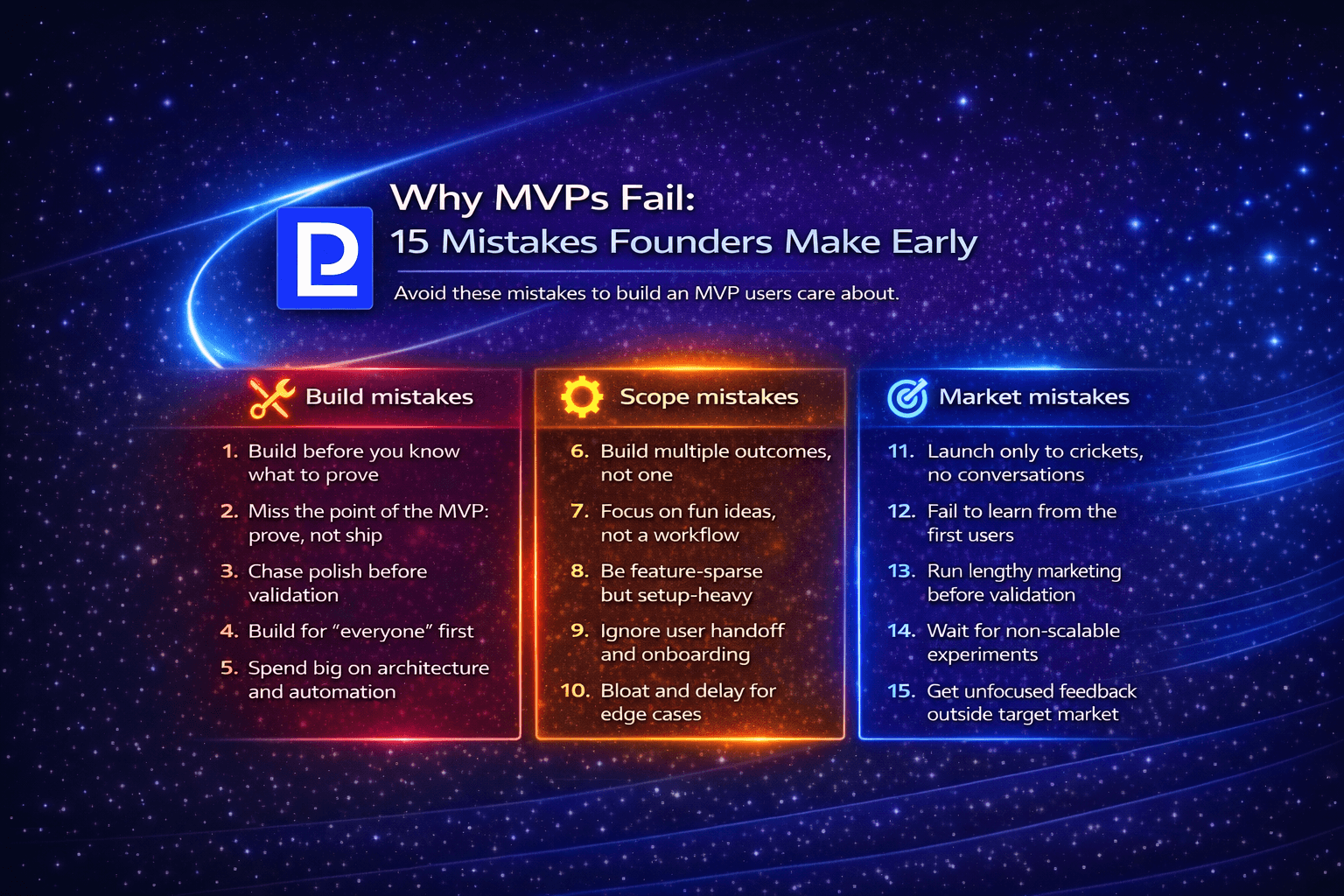
Why MVPs Fail: 15 Mistakes Founders Make Early
A founder-focused guide to the 15 most common MVP mistakes: what causes failure, how to avoid them, and how to build MVPs that actually validate.
Technology • 3 min
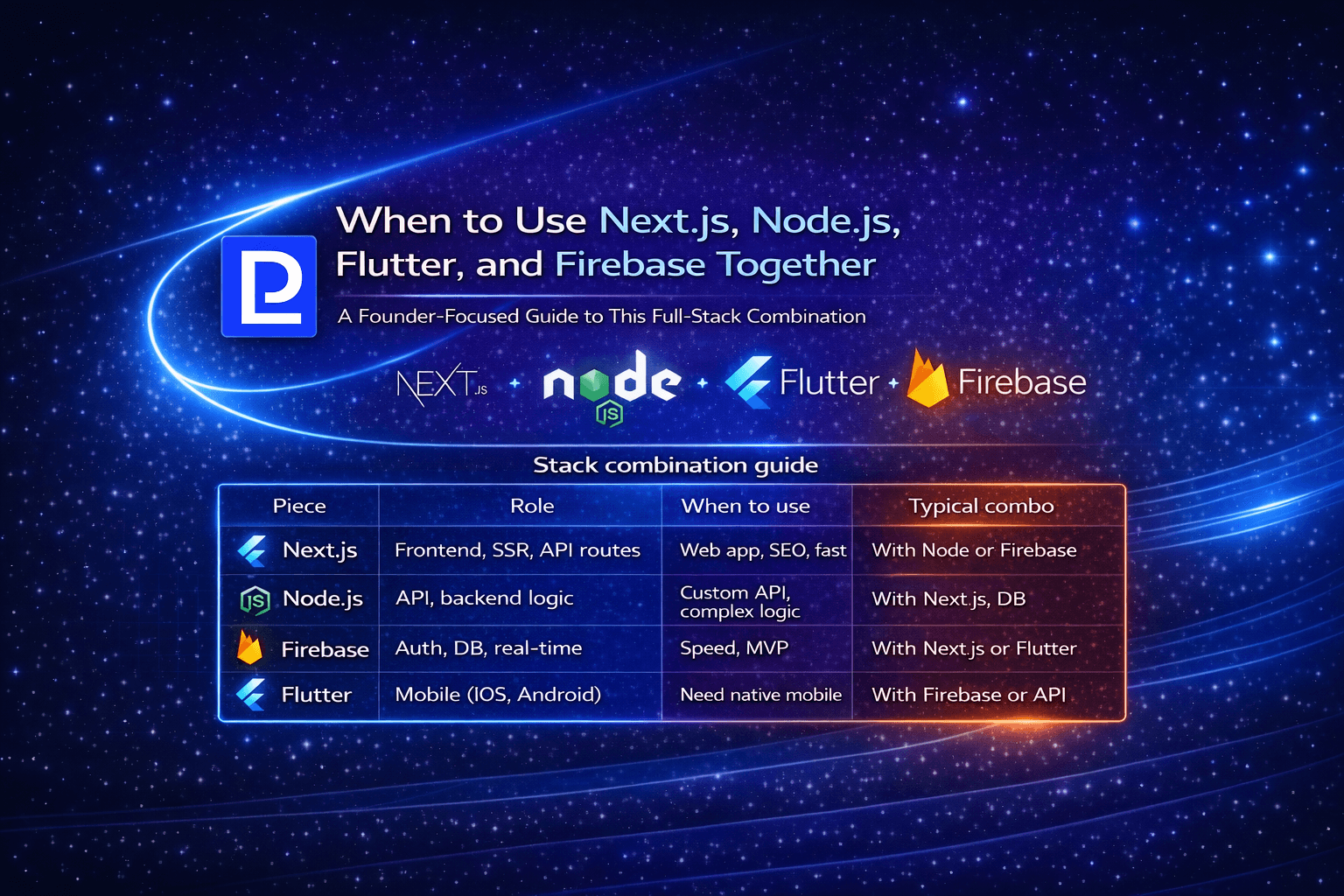
When to Use Next.js, Node.js, Flutter, and Firebase Together
A founder-focused guide to combining Next.js, Node.js, Flutter, and Firebase: when the stack makes sense and how to use them together.
Technology • 3 min
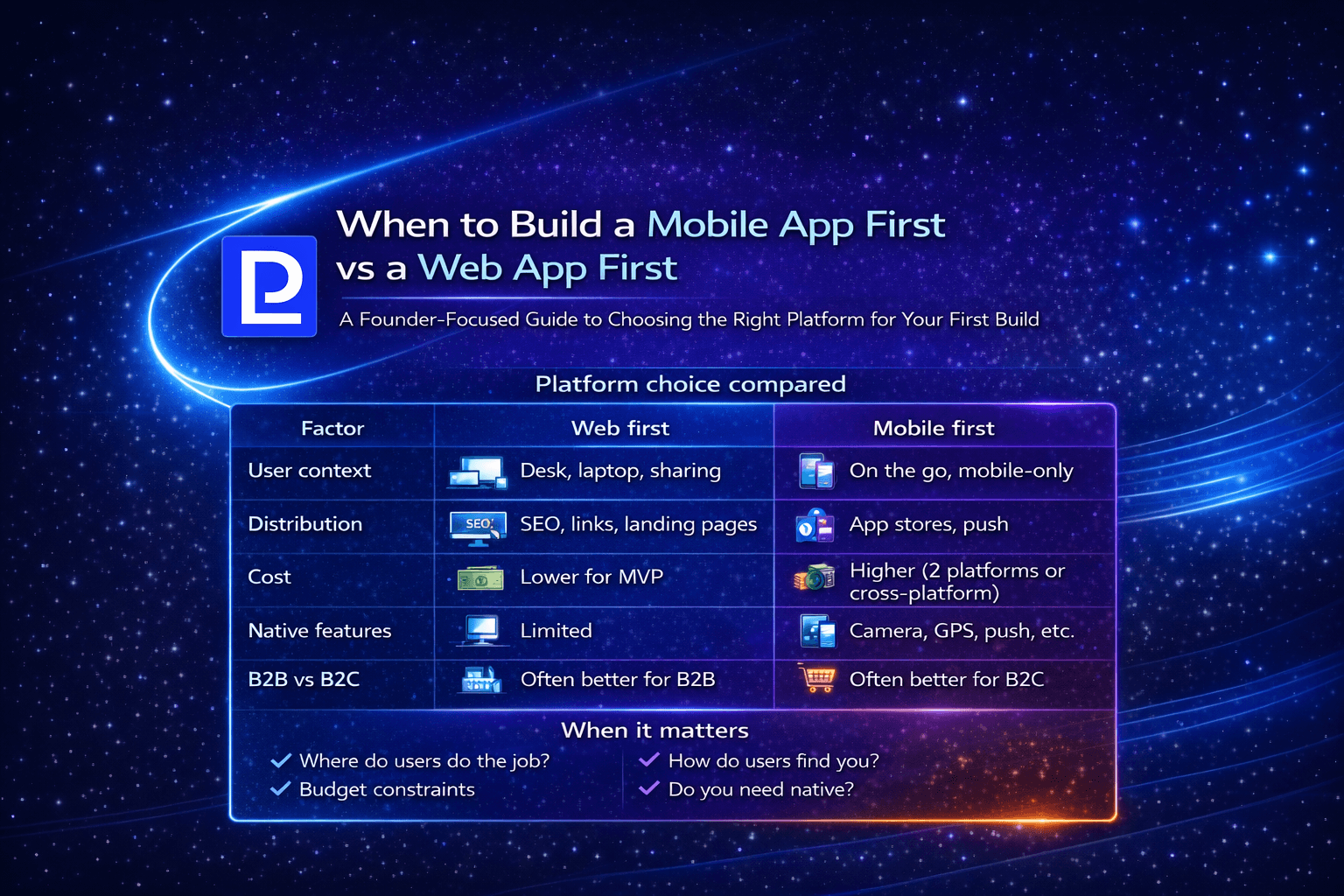
When to Build a Mobile App First vs a Web App First
A founder-focused guide to choosing mobile-first vs web-first: when each makes sense, tradeoffs, and how to decide for your product.